Showing posts with label Thailand. Show all posts

Thursday, July 23, 2009

Clear Path International Provides The Gift of Hands for the Landmine Survivors at Care Villa

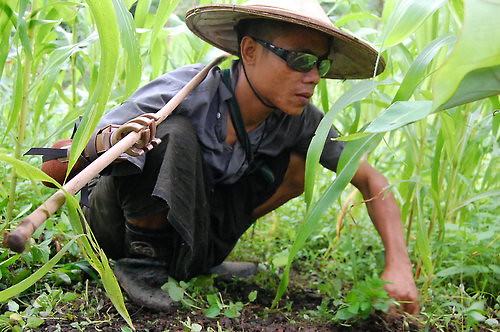
Palaw Weeding
Palaw weeding after receiving a prosthetic hand from Clear Path International


By Melody Mociulski

Mae Sot, Thailand - Since we began supporting the Care Villa in 2002, we at Clear Path have dreamed of providing prosthetic hands for the amputees we serve there. Many of them have lost one or both arms in a landmine explosion and are wholly dependent on others for their care. Almost every time we visit our Karen friends at the giant sprawling Mae La refugee camp on the Thai-Burma border, we are asked for a device that will allow the men to use their upper limbs.
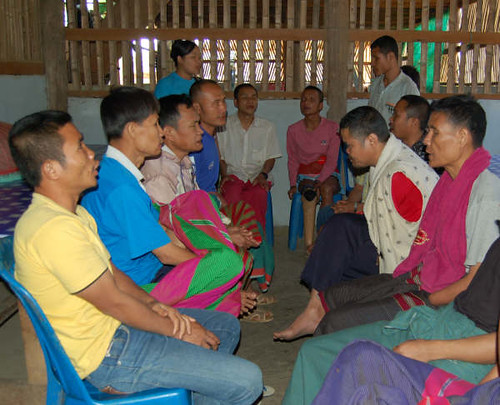
Landmine Survivor at Care Villa, Thailand


Now, two young American volunteers, Missy Malkush and Rachel Clagett, have made the dream come true. They arrived at the Care Villa this month with the gift of hands.

Care Villa, located about an hour from the Thai border town of Mae Sot, is a 24-hour residential care facility for 18 physically-handicapped, dependent Burmese landmine survivors who have lost their eyesight, hands, legs, hearing, or some combination. Most all suffer post-traumatic stress syndrome and depression. They are marginalized by their community and are considered a burden to their families who already live in impoverished conditions.

Clear Path International is the primary source of support for these 18 men, aged 15-65, providing shelter and daily caretaking. To help the men deal with the anguish of their situation, music provides an outlet for their voices to be heard. A song written by one of the men describes their spirit to heal and find fulfillment in their lives.


I lost my eyes, so I can't look at you.
I lost my arms, so I can't hold you.
I lost my legs, so I can't come with you.
My heart is broken, but I've still got my voice.
So I'll sing.


Rachel, pursuing a Doctorate in Physical Therapy, and Missy, with a Master's in Prosthetics and Orthotics, have been friends since their freshman year at Wake Forest University. They found themselves at a complacent point of their lives, and on a whim and unbeknownst to each other, each googled landmine victims and discovered Clear Path. A few months later they began their journey to Mae Sot to volunteer with Clear Path at the Care Villa and the Mae Tao Clinic to help landmine victims.

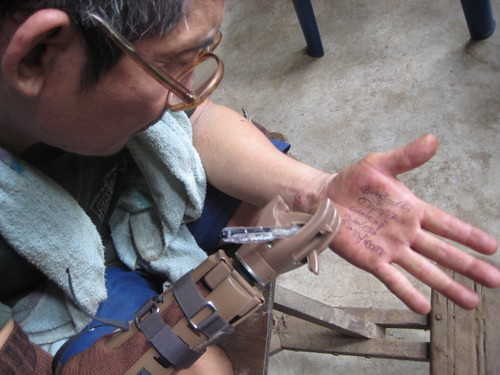
Hearing about the needs of the men at the Villa, Missy reached out to a colleague at LN-4 Hand, a non-profit in California which has designed prosthetic hands for developing countries. The hands are simple, innovative and easily fitted. With a protective sock worn underneath, the universal size prosthetic is wrapped around the limb and secured tightly over the bones of the elbow joint with a Velcro cuff. A combination of stationary and adjustable prongs provides multiple gripping patterns to fit the amputee's needs. LN-4 Hand generously donated 10 hands which Missy and Rachel personally carried with them to Mae Sot.

Training is essential for using a prosthesis. If one does not know how it can be helpful, it is just as good on the shelf. The Care Villa men have lived for more than 10 years without one or both hands. They have loving people to help them with their activities of daily living. They may not want to wear a device. However, waking up and brushing one's own teeth, or being able to bring a fork to one's own mouth provides a sense of independence. Missy and Rachel hope that "they are not only providing these men with a limb", but that they are showing the men that "they can do even more than they thought possible".
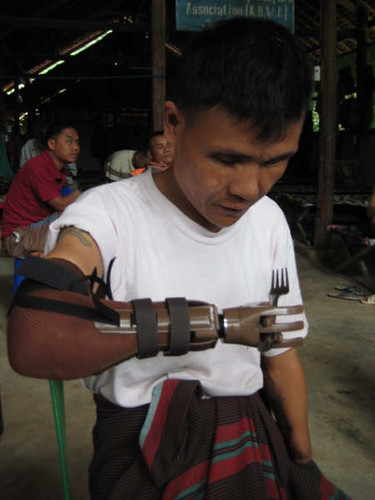
Landmine Survivor at Care Villa, Thailand


Missy and Rachel brought cucumbers and cake for the first training session. The cucumbers were fantastic because once jabbed, they did not go anywhere until they were in the mouth. Remembering that most of the men are blind, the last thing they wanted was to discourage them by continually bringing an empty spoon to their mouths. The cake was for the tongue's delight. Cucumbers and cake - a suitable midday meal for a new hand or a pair of new hands.
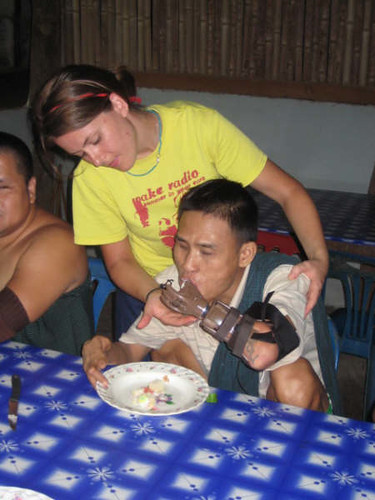
Landmine Survivor at Care Villa, Thailand


Tupo lost his sight in only one eye. As he could see how to use the new prosthetic, he learned quickly and easily. The first thing Tupo wanted to do was to hold a pen in his right hand and write, something he had not been able to do for far too many years. Although the Burmese script is beautiful, it is difficult to write with its many circles and curves. With his new prosthetic hand, he happily wrote all over his left hand and in a notebook - an exciting moment.
Landmine Survivor at Care Villa, Thailand
Tupo writing Burmese again


In a place where time moves slowly and dreams seem out of reach, the gift of hands from Missy and Rachel and LN-4 Hand has brought new hope and excitement to the 18 Burmese residents of the Care Villa. Missy and Rachel: a heartfelt thanks from all of us at Clear Path!

Monday, March 9, 2009

Clear Path International Releases Annual Report

cover.jpg
In a one-year period, Clear Path International assisted more than 9,400 landmine accident survivors, persons with disabilities and members of their families in five countries, as you can read in our 2007 � 2008 annual report.

The number of 2007 � 2008 beneficiaries is more than CPI served in its entire history since 2000. It stems largely from our new Afghanistan operation and from a record number of bomb survivors assisted in Vietnam during the period. CPI�s other program activities are in Cambodia, Thailand and just inside Burma.

In the period covered by the report, we have assisted 6,325 beneficiaries in Afghanistan, 1,679 in Vietnam, 929 in Cambodia and 538 on both sides of the Thai-Burma border.

The report covers the breadth of services CPI offers, ranging from prosthetic care and physical therapy to vocational skills training and support for sports activities. We've raised nearly $1.3 million in 2007 � 2008 and spent $878,950, or 87.2 percent, of its operating expenses on program services.
Download a copy of Clear Path International's 2007 � 2008 Annual Report here.


Monday, March 17, 2008

YouTube: Myanmar's Landmine Survivors at the Mae Tao Clinic

A video of the clinic we support on the Thai Burma border and an interview with Dr. Cynthia (known as the Asian Mother Theresa) who runs it.

You can read more about our program here.


Monday, February 18, 2008

CPI Aid in Thailand and Myanmar Reached Nearly 300 Landmine Survivors in 2007

Shan Refugee Camp Thailand Burma Border

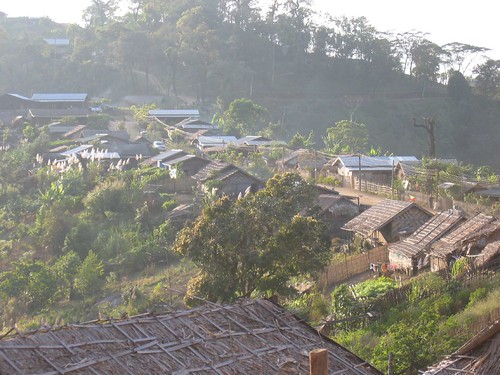
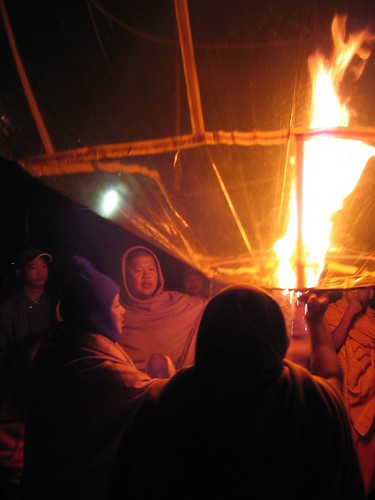
Lobke Dijkstra, our Thailand Country representative, and I traveled to a remote refugee camp on the Thai border with the Shan state to observe New Year with many of the camp�s 2,000 residents.

Shan Refugee Camp Thailand Burma Border

The Shan lunar calendar puts the New Year in December, so we marked the occasion well before the end of our program year. But it didn�t seem too early to celebrate with some of our beneficiaries.

Shan Refugee Camp Thailand Burma Border

Last year was very successful for our Thai-Burma border initiative which has already served more than 500 landmine accident survivors since its inception in 2002. In 2007, thanks to Lobke�s tireless coordination, management and fundraising, we served 298 Karen, Karenni and Shan survivors in five different locations along the Myanmar border.

Most of our beneficiaries, 278, received new or repaired prostheses, plus we provided full-time nursing care to about 20 severely disabled survivors at a UNHCR refugee camp at Mae La. Forty-one technicians and medics received training and compensation for their aid activities from prosthetics fabrication to physical rehabilitation.

We received funding for this effort from the Dutch rehabilitation hospital Groot Klimmendaal in Arnhem, the Dutch charity Mensenkinderen, Bainbridge Community Endowment, Susila Dharma UK, Susila Dharma USA and Susila Dharma Netherlands, Grace Episcopal Church and Cedars Unitarian Church both on Bainbridge Island.

For its relatively modest budget of $53,000, the program has had great leverage in the field thanks to its volunteers, including Lobke and two prosthetics students from British Columbia, Duane Nelson and Jody Riggs, who spent their summer making 18 Monolimb prostheses for survivors at a Shan camp.

This year, we hope to expand the breadth of our services with income-generating projects, such as pig breeding, mechanics training and other skills instruction at or near two Shan border camps while we continue to support prosthetics fabrication, physical rehabilitation and full-time care for severely disabled survivors.

With our partners, the Mae Tao Clinic, the Karen Handicap Welfare Association, KNPLF (Karenni) and the Shan Health Committee, we expect to provide services to more than 400 survivors at seven locations along the border in 2008. Groot Klimmendaal, Lobke�s employer, has been encouraging its other employees to volunteer in the area. Neeltje Rosmalen, a psychologist and cognitive trainer helped train medics and counselors in psychological treatment of new and existing accident survivors.

Shan Refugee Camp Thailand Burma Border

Monday, January 28, 2008

The Scent of Northern Thailand: A Volunteer's Experience on the Thai-Burma Border

By Betsy Boyce
Physical Therapy Student
Home: Seattle, WA

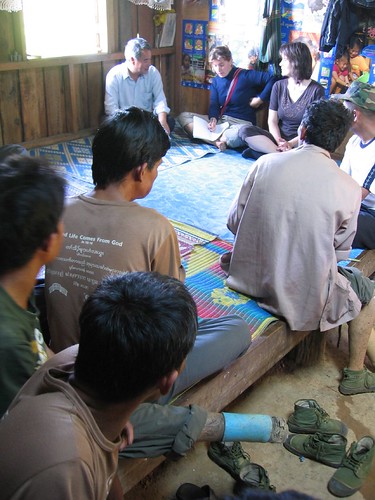
On my first morning at the Mae Tao Clinic, I was greeted by what I know as the scent of northern Thailand: an odor that combines fish paste, mildew, sweat, and betel nut. Just past the clinic entrance, a crowd of people, each with a small bag of clothing, sat or stood in the courtyard hoping to receive medical attention, food, and temporary shelter. I soon learned that some of these people had traveled for days or weeks from inside Burma or from refugee camps on the border, often in danger of being caught and detained by border officials. As Lobke, the physical therapist who volunteers there, led me past the crowd and through layers of sandals scattered at the entrance of each small open-aired concrete building, she described the work in store for us in the inpatient, surgical, pediatric, outpatient, and prosthetics departments.

Over the next six weeks�from October to mid-November 2007� Lobke provided me with instruction and demonstrations on stump care and rehabilitation for patients with amputations, passive mobilization, and functional exercises. We then worked together to evaluate and treat patients. Taking into account patients� circumstances and offering the therapy and advice that best met their needs was especially challenging because most of the patients came from precarious living situations, where they were dealing with extreme poverty; lack of food, water, and healthcare; and forced labor or relocation. Many patients also faced landmine hazards and other atrocities under the Burmese military�s ruthless control. By paying close attention to the patients� behaviors and by being deliberate with my facial expressions and voice tones, I strived to offer patients some physical relief, encouragement, and a sense of being cared for.

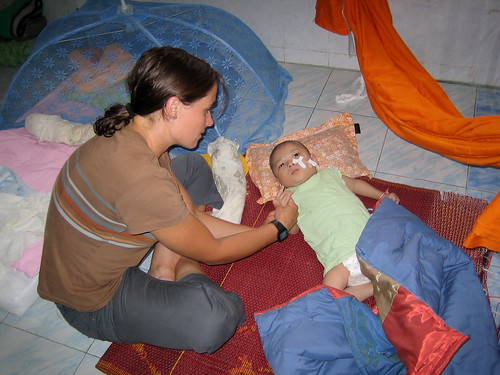
What they gave back to me was immeasurable. For example, providing therapy to a woman who had fallen unconscious after a seizure and then exhibited neurological dysfunction was challenging, but also very satisfying. When we began treatment, the patient lay quite motionless, showing little awareness of her surroundings. Gradually, she improved and, after ten days of therapy and rest, she smiled, made eye contact, and walked with my support. Observing her progress and watching her confidence return reinforced my belief in physical therapy and my aspiration to join the profession.

My time volunteering at the Thai-Burma border strengthened my heart and mind, pushing me to grow and learn both as a person and as a physical therapy student. Experiencing the challenges first-hand of connecting with each patient and sorting out the most fitting treatment has deepened my understanding of what it means to be a physical therapist and has further prepared me for my future career. I hope to continue to volunteer with Clear Path, and I look forward to returning as a physical therapist to contribute to and learn from the Mae Tao Clinic.


betsy boyce on the thai burma border

Friday, January 11, 2008

Young & Rubicam Creates Radio Spot to Support Landmine Victims: Tell us what you think!

All of us at Clear Path International are grateful to Young & Rubicam Malaysia (and Randy Lee!) for creating a 35 second radio spot for CPI.

Please listen to the spot below and let us know what you think in the comments section.

It is our hope to get this played on radio stations, so if you are in radio, or know of someone who is, please help us get this on the air! If you have ideas, please email us at info@cpi.org.

Listen to the ad here or right click on this link and save it to your computer!

Download the .Wav file (for radio) here.

Monday, November 12, 2007

Good News, Bad News For Mine Clearance In Countries Where Clear Path International Has Assistance Programs

The year 2006 held some good news and some bad news for the countries where Clear Path has assistance programs for landmine accident survivors, according to Landmine Monitor

Landmine clearance efforts in Cambodia and Afghanistan led the way in global mine removal, accounting for 55 percent of the world's total in 2006. But the use of anti-personnel devices and casualties increased sharply in Myanmar (Burma) during the year.

The below is a release from the International Campaign to Ban Landmines:

TOO MANY STATES NOT ON COURSE TO MEET MINE CLEARANCE DEADLINES

GENEVA, Switzerland � 12 November 2007 � Many states are not on course to meet their Mine Ban Treaty mine clearance obligations, according to Landmine Monitor Report 2007: Toward a Mine-Free World. The International Campaign to Ban Landmines (ICBL) releases the 1,124-page report at the United Nations today.

Landmine Monitor reports on the global landmine situation and scrutinizes the implementation of and compliance with the 1997 Mine Ban Treaty. Landmine Monitor Report 2007 is the ninth annual edition of the report.

Time is running short for 29 countries with treaty-mandated clearance deadlines in 2009 or 2010. Despite a treaty provision allowing 10 years to complete mine clearance, 14 states are almost certain not meet their 2009 deadlines: Bosnia and Herzegovina, Cambodia, Chad, Croatia, Mozambique, Niger, Peru, Senegal, Tajikistan, Thailand, the United Kingdom (for clearance of the Falkland Islands/Malvinas), Venezuela, Yemen, and Zimbabwe.

Even more seriously, despite having almost eight years to initiate clearance, France, Niger, the United Kingdom and Venezuela have failed to even begin clearance operations.

�Some countries that should have met their clearance deadlines will probably not be able to do so,� said Mr. Stuart Casey-Maslen of Norwegian People�s Aid, Landmine Monitor�s Mine Action Editor. �Both donors and mine-affected countries must work harder to ensure that countries live up to their obligations under international law.�

Demining programs in 2006 cleared 140 km2 of mined areas and 310 km2 of battle areas. A significant increase in battle area clearance was recorded over 2005, primarily in Iraq. Afghanistan and Cambodia alone accounted for over 55% of all mined area clearance in 2006. Operations resulted in the destruction of 217,000 antipersonnel mines, 18,000 antivehicle mines and 2.15 million explosive remnants of war (ERW).

Government use of antipersonnel mines declined further, with only Myanmar/Burma and Russia continuing to lay new mines. Non-state armed groups in at least eight countries used antipersonnel mines or improvised explosive devices, which is also a decrease.

A total of 5,751 mine and ERW casualties were reported in 2006, a decrease of 16% from 2005, although Pakistan, Myanmar/Burma, and Somalia recorded increased casualty rates due to conflict. Lebanon noted an approximately tenfold casualty increase. Three-quarters of recorded casualties were civilians, and 34% of civilian casualties were children. Worldwide, 473,000 survivors were identified as of August 2007.

Only 11 of 24 states with significant numbers of survivors have made substantial progress towards their 2005-2009 objectives for improving the provision of assistance and ensuring survivors� rights. Funding for survivor assistance comprises only 1% of total mine action funding. Progress toward meeting the needs and rights of survivors should be regarded as insufficient.


�Mine-affected countries and international donors must give greater priority to the physical and economic rehabilitation of survivors, as their needs are not being adequately addressed,� said Katleen Maes of Handicap International, Landmine Monitor�s Victim Assistance Editor. �These people must not be forgotten.�


Mine risk education reached approximately 7.3 million people in 63 countries in 2006-2007. Although this is an increase from 2005-2006, 13 countries urgently need to improve their mine risk education efforts. No mine risk education was recorded in 36 countries and one area affected by mines or ERW.

Of the 20 largest mine action donors, 15 provided more funding in 2006 than 2005. Funding for mine action was US$475 million in 2006, an increase of some $100 million from 2005, and the highest level ever recorded by Landmine Monitor. Much of the increase was due to emergency funding for the clearance of explosive remnants of war in South Lebanon.

�While donor states responded quickly to ERW contamination in Lebanon, what is needed is multi-year funding by national and international donors,� said Mr. Anthony Forrest of Mines Action Canada, Landmine Monitor�s Mine Action Funding Editor. �Funding levels in 2006 have set a new standard for the global commitment to mine action, against which future funding levels will be judged."

Antipersonnel mines face increased international rejection, as four more countries joined the treaty (Indonesia, Iraq, Kuwait and Montenegro), bringing the total to 155. �Ten years after the negotiation and signing of the Mine Ban Treaty, the stigmatization of antipersonnel mines continues to spread. Even those who have not yet joined the treaty are largely abiding by its core obligations,� said Steve Goose of Human Rights Watch, Landmine Monitor�s Ban Policy Editor. Seven more countries completed destruction of their stockpiles of antipersonnel mines; in total, 81 States Parties have destroyed nearly 42 million stockpiled mines.

�While overall compliance with the treaty has been impressive, there have been some disconcerting developments,� said Goose. These include a UN monitoring group reporting shipments of antipersonnel mines to Somali factions by two States Parties (Eritrea and Ethiopia, which strongly deny the accusations), two states missing their stockpile destruction deadlines (Afghanistan and Cape Verde, both of which have now completed the task), and Venezuela indicating that it continues to derive military benefit from mines laid around military bases�a potential treaty violation of the prohibition on use.

The treaty prohibits the use, production, and trade of antipersonnel landmines. It requires clearance of mined areas within 10 years and the destruction of stockpiled antipersonnel mines within four years. Landmine Monitor Report 2007 reports on landmine use, production, trade, stockpiling, demining, casualties, survivor assistance and mine action funding in 118 countries and areas.

Landmine Monitor is coordinated by an Editorial Board drawn from four organizations: Mines Action Canada, Handicap International, Human Rights Watch and Norwegian People�s Aid. It constitutes a sustainable and systematic way for NGOs to monitor and report on the implementation of a disarmament treaty.

Landmine Monitor Report 2007 and related documents are available at 08:00 GMT at www.icbl.org/lm/2007on 12 November.

For more information or to schedule an interview contact:

Ms. Jackie Hansen, Landmine Monitor Project Manager, Geneva (GMT+1), Mobile +41-76-222-6968 or +1-613-851-5436, email lm@icbl.org
Ms. Simona Beltrami, ICBL Advocacy Director, Geneva (GMT+1), Mobile +39-33-3714-2251, email simona@icbl.org


Thursday, November 1, 2007

Running marathons for landmine surivors: Thanks Darcy!

Working with Clear Path International has offered me the great privilege of meeting many amazing people around the world. Not a day goes by that I don't think about the folks that tirelessly, quietly and selflessly continue to support this important work.

Mr. Darcy Ike is positioned well within the group of amazing folks with whom I have been honored to cross paths. Mr. Ike runs marathons, 34 so far and has chosen to contribute to Clear Path with the completion of the past several and hopefully the next handful in the future :)

In the photo below from a recent marathon on Maui, Darcy is wearing a shirt that was designed by his friend Tim Geer. It features a simple drawing of Aung San Suu Kyi and two messages - on the front "Free Aung San Suu Kyi" and on the back - "Running for Clear Path".

Stay tuned for more about Mr. Ike's efforts but for now all of us here are grateful for the miles that he has tread for Clear Path International.

Darcy Ike's 33rd Marathon on Maui.jpg


Monday, October 22, 2007

YouTube: Thank you, Martha!


This video was shown on the 10th anniversary Celebration of Martha Hathaway's work with landmine and bomb survivors in Vietnam, Cambodia, Afghanistan and the Thai-Burma border.

The music is Natalie Merchant's "Kind & Generous" off of her CD OPHELIA and is used with permission.

It was shown (as a surprise to her) at on October 13th after a letter from the US Dept of State was read and before a speech by Senator Patrick Leahy and a performance by Sarah Lee Guthrie and Johnny Irion.


Wednesday, October 17, 2007

Senator Leahy Honors Clear Path | Sarah Lee Guthrie and Johnny Irion Perform to a Sold Out Crowd

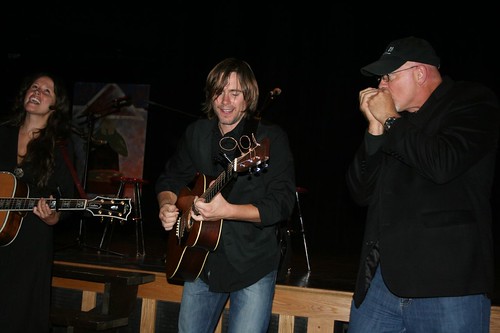
Great news from the Vermont Office of Clear Path International! Our event with Sarah Lee Guthrie and Johnny Irion was a huge success bringing in around $10,000.00 in donations and ticket sales! We sold out of over 200 tickets and it was standng room only... and those standing didn't seem to mind as Sarah Lee and Johnny put on a stellar performance.

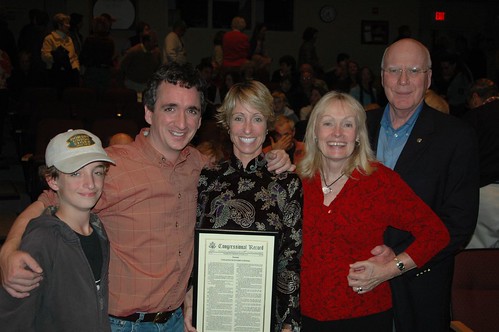
Before the show, CPI honored one of its own... it was CPI executive Director Martha Hathaway's 10th year in mine action. In honor of this occasion, Senator Patrick Leahy spoke before Sarah Lee and Johnny took the stage and spoke to the need for a ban on landmines and praised the work of Clear Path International. He then presented Martha and me with a framed copy of comments he made about Clear Path that are now in the Congressional Record.

This was a great honor for Martha, Clear Path and me. Please see photos below and more pictures from the event can be found at this link.

Thank you Sarah Lee, Johnny and Senator and Mrs. Leahy!! I also especiallly want to thank John Goodrow from Leahy's office... he is truly an unsung hero... he fields so many calls for the Senator's attention and has done so much for so many. Thank you, John, for your good work for us and for many, many other causes. The photo below, with the Senator, was taken by John.

Leahys with Clear Path Co-Founders James & Martha Hathaway and their son Ryder

Sarah Lee Guthrie and Johnny Irion performing for Clear Path International


A special thank you to our sponsors for the event:

A Safe Place Self-Storage, Alchemy Promotional Products, Bickford Real Estate, Chandler 4 Corners, Dorset Union Store, Engel, Powell & Spivey, P.C., Express Copy Inc., Finn & Stone, Inc., Bob Gasperetti Furniture Maker, Gunterman Tennis Schools, H.N. Williams Store, The Inn at Manchester.Inn At West View Farm, Lisa Laberge Interiors, Long Ago & Far Away,Main Street Realty McWayne Jewelers, The Mountain Goat, New Morning Natural Foods, Northshire Bookstore, The Orvis Company,Perfect Wife Restaurant, Simple Coffee, Susan Sargent Designs, The Kitchen Store At J.K. Adams


Tuesday, October 9, 2007

AP: Villagers flee Myanmar�s deadly landmines

The story below is from the Mae Sot Clinic on the Thailand - Burma (Myanmar) border that Clear Path International has been supporting since 2002.

Villagers flee Myanmar�s deadly landmines

...In 2005, at least 231 people in Myanmar were killed or maimed by landmines planted by both the government and insurgent groups including the Karen National Liberation Army, the armed wing of the KNU, the report said.

People treating the victims in Thailand fear that the figure is rising.

Cynthia Maung, the founder of the Mae Tao Clinic, said the number of landmine victims has been growing since 1997 and thinks that it may double this year as the junta�s troops advance through Karen State.

�Every year we receive about 30 to 40 landmine victims,� she told AFP, adding that she�s seen nearly 50 cases so far this year.


Read the rest of the story here.

018maesot

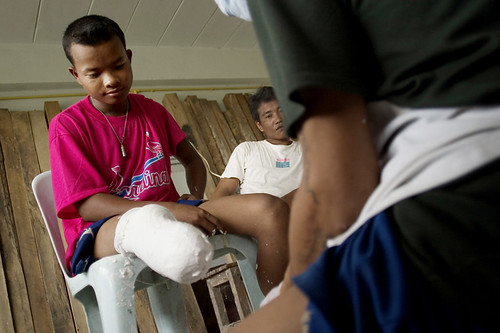
A landmine survivor is fitted at the Mae Tao Clinic in Mae Sot

Tuesday, October 2, 2007

Sarah Lee Guthrie and Johnny Irion with Senator Patrick Leahy Benefit Clear Path International!


slgjipl2.gif
Sarah Lee Guthrie, the granddaughter of Woody Guthrie and the daughter of Arlo, will be returning to perform in southern Vermont with her husband, the critically acclaimed Johnny Irion on Saturday October 13th at 6:30 pm at Dorset Vermont's Long Trail school!


The event will benefit Clear Path International's work with landmine and bomb survivors in Vietnam, Cambodia and the Thai-Burma Border. Speaking before the event will be long-time Clear Path supporter and landmine victim advocate, Vermont's Senator Patrick Leahy.


Please click the BUY NOW button below to purchase tickets!


Acoustic Magazine had this to say about Sarah Lee and Johnny's 2005 CD entitled "Exploration":

"The celebrated Guthrie musical legacy appears to be in capable hands. This duo debut from Arlo's daughter/Woody's granddaughter and her singer-songwriter husband carries the family folk-music torch into rock and country territory with style and spirit to spare."


Read more about Sarah Lee Guthrie and Johnny Irion here: www.sarahleeandjohnny.com


Thank you to our sponsors!


A Safe Place Self-Storage, Alchemy Promotional Products, Bickford Real Estate, Chandler 4 Corners, Dorset Union Store, Engel, Powell & Spivey, P.C., Express Copy Inc., Finn & Stone, Inc., Bob Gasperetti Furniture Maker, Gunterman Tennis Schools, H.N. Williams Store, The Inn at Manchester.Inn At West View Farm, Lisa Laberge Interiors, Long Ago & Far Away,Main Street Realty McWayne Jewelers, The Mountain Goat, New Morning Natural Foods, Northshire Bookstore, The Orvis Company,Perfect Wife Restaurant, Simple Coffee, Susan Sargent Designs, The Kitchen Store At J.K. Adams


Thursday, August 2, 2007

O & P Edge: CPI Clearing the Way for a Safer Future

The below is an excerpt from a very well-written and researched piece by Brady Delander who interviewed Martha, Imbert and me. He would have talked to Kristen too, but she is pretty busy over in Afghanistan at the moment!

Thanks, Brady!!

CPI: Clearing the Way for a Safer Future


By Brady Delander

Will and determination help expand worldly mission of Clear Path International.

James Hathaway was late for his flight�"of course," he says�when he saw his opportunity. Imbert Matthee was deep in the jungles of Vietnam when the purpose of his efforts crystallized. Such is the world of humanitarianism. Anything can happen at anytime? it usually does.

Hathaway and Matthee, along with Martha Hathaway and Kristen Leadem, are the co-founders of Clear Path International (CPI), an organization established in 2000 originally dedicated to the removal of unexploded ordnance�landmines, clusters bombs, etc.�in war-torn locations around the globe that now focuses on helping the victims of such explosions. "There is certainly no shortage of work," says Martha Hathaway, CPI's executive director and co-founder.

The bulk of that work is deadly serious. With programs in Vietnam, Cambodia, along the Thai-Burma border, and now Afghanistan, the realities of war�even wars that ended more than 30 years ago�could not be any more dramatic. Dealing with the everyday horror can be overwhelming, but Matthee recalls a moment that makes even the most trying days seem worthwhile.


Read the rest of this story here.

Thursday, July 19, 2007

Elephants "Learn" to Avoid Land Mines in War-Torn Angola

In the past I have posted about elephant landmine victims on the Thai-Burma border. The article below from National Geographic shows that elephants are learning to avoide minefields... but they are not sure how, exactly.

Ian Whyte is senior researcher at South Africa's flagship Kruger National Park, which has an estimated 13,000 elephants within its boundaries

He said the animals may well be able to develop the ability to avoid mined areas. But exactly how they do it�whether it's by true learning or by an ability to detect the mines somehow�is a matter of conjecture.

"Maybe they are able to smell the mines," Whyte said. "They move about with their trunks right on the ground, and it could be that they pick up the scent in this way.

"But they are also intelligent animals which move in groups. Maybe they learn to avoid places where they see other elephants get blown up."


Read the rest of this article here.

Tuesday, July 17, 2007

Clear Path Burma Site: Landmine death toll rises in Karen state

This news comes from the Clear Path International funded landmines victim clinic at the Mae Tao clinic on the Thai-Burma border.

Souce: Democratic Voice of Burma

Landmine death toll rises in Karen state


Vietnam, Cambodia, Thailand, August 2004 560
July 05, 2007 (DVB)�The number of people killed by landmines in Karen State has increased dramatically this year as tensions continue between rival Karen rebels, according to staff at the Mae Tao clinic on the Thai-Burma border.

Saw Eh Thamwe, the coordinator of the clinic�s mine victim department, said that the clinic had treated 16 people injured by landmines in June alone and that increased tensions between the Karen National Union and the Democratic Karen Buddhist Army were to blame.

�This year has the highest number of land-mine cases due to intensified fighting. in previous years, there were as few as ten landmine cases a year but in the first six months of this year we had 30 cases,� Saw Eh Thamwe said.

Married couple U Pho Htin and Daw La Pyait from Maw Htoo Tha Lae village near Myawaddy were bought to the clinic yesterday after they were injured by a landmine while gathering bamboo shoots in the jungle in the early morning.

�The wife lost both of her legs and her husband has gone blind. Because their wounds were quite serious we have sent them to the Mae Sot hospital with the assistance of the [International Committee of the Red Cross,� Saw Eh Thamwe said.


See photos of our work on the Thai-Burma border here.
See previous blog posts on the Thai-Burma border here.

Monday, July 16, 2007

Reuters: Decade after Diana campaign, few use landmines

From Reuters:

Decade after Diana campaign, few use landmines


Mon Jul 16, 2007 9:31 AM BST
By Peter Apps


LONDON (Reuters) - Ten years after the death of Princess Diana and the first global treaty against antipersonnel landmines, experts say only a handful of rebel groups and perhaps one state dare use what has become a pariah weapon.


note from Clear Path: The one state is the state of Myanmar (Burma). Clear Path funds clinics to assist landmine survivors on the Thai-Burma border. You can read more here.
Landmine clearance agencies say it will likely take another decade to clear probably the world's two most affected countries -- Angola in southern Africa and Cambodia in Southeast Asia -- both the scene of long-running but now ended civil wars. Ongoing conflicts delay clearance in Iraq, Afghanistan and elsewhere.

But fewer are now being laid and many activists have moved on to a campaign against cluster munitions in the aftermath of last year's Lebanon war, which left much of the country's south seeded with small unexploded bomblets.

"There is a global stigma attached to landmines now," said Paul Hannon, executive director of pressure group Mines Action Canada.


Read the rest of the article here.


Saturday, July 14, 2007

Jody Riggs: Burma�s situation is real!

note: Jody Riggs is currently volunteering on the Thai-Burma border with Clear Path International. He sent me this post by email. You can read more of his blog here: http://bcitpando.blogspot.com/index.html

This is not history! That is what continues to ring in my head. My name is Jody Riggs and I am a student prosthetist from Canada. The atrocities that I am reading about and the repercussions that I am witnessing are current events, happening just over those hills and across the Moei or the Salween river in Burma.

The victims of malnutrition, curable diseases, displacement from homes, forced labour, unfair imprisonment, landmine explosions are all around me. This is heart wrenching, though if we don�t keep faith how will these Burmese ethnic groups keep their faith?

Over the past four weeks I have been inspired to keep hoping and to assist in the solution. The work of international volunteers, representatives from various media sources and most importantly the Karen and other ethnic groups themselves do fill small voids but so much more needs to happen.

My life has been changed, my heart hurts each time I contemplate the depth of this situation. There needs to be more international awareness so that change can be brought to Burma. I encourage you to take a minute and look at this news article, my pictures and search topics like Daw Aung San Suu Kyi, Thai Burma Border Consortium, Free Burma Rangers, Clear Path International.

Choose to be aware�


Sunday, June 24, 2007

In Another World, You Are An Illegal Refugee With Nothing To Your Name

note: Duane Nelson is blogging from the Mae Tao Clinic in Mae Sot, Thailand where Clear Path funds a prosthetic clinic for landmine survivors. The post below was sent in by him today.

This week I had the opportunity to see the contrast between two worlds that literally rub shoulders yet are essential separated by a great chasm. In one world, you are a citizen and have access to free healthcare and sanitation and technology, in the other world, you are an illegal refugee with nothing to your name.

The Mae Toa Clinic on the Thai-Burma border is founded and run by refugees. The prosthetics department manager is an astounding and committed man. He does not make money and will never be able to buy his family a truck, or a home, or a vacation. His workshop lacks government funding and only survives by donation and outside funds. His shop is built on rented land and therefore lacks stability and his limited budget doesn�t allow for expensive tools. They make do with their space and use what they have. They have no specific prosthetics grinding machines, no specialty tools, no ventilation extraction for harmful chemicals and dust, no glass windows, no waiting room, no casting room, no privacy for patients.

Prosthetics Manufacturing on Thai-Burma border.jpg


Despite these lacking luxuries they are a very productive shop effectively fabricating 200 prostheses per year free of charge, and training 10 new prosthetists in that same time.

Approximately 3km away there is another prosthetics work shop� at the Mae Sot Municipal Hospital. This is a Thai government funded facility. The manager here parks his beautiful new 4X4 out front and steps into his immaculate and polished lab. All the most specialized, advanced and brand name equipment line the walls. There is a ventilated grinding room, an outfitted casting room, a well stocked storage room, and a huge personal office with a solid wood desk, computer, and phone. This is a fantastic place to work for the manager; he�s got it made, life is good. Everything is funded by the government and the advanced prostheses are provided free of charge to Thai citizens. The only problem is, there is no work�he sits around all day� approximately only 50 prosthesis are made here in a year� because there is no need.


Unless of course, he could welcome landmine survivor refugees into his clinic. On his geographic doorstep lies one of the greatest volumes of prosthetic need in the world. But, he is forced to charge refugees up to 20,000 baht for a leg when most of them are lucky if they can afford a bag of rice.


Its kinda warped, this contrast of worlds. The ability to meet the needs in a greater way is right here, 3km away. I guess it�s the same question of "why do people still starve in today�s world when we all know there is plenty of food to go around?".


Tuesday, June 12, 2007

Duane Nelson on the Thai Burma Border

webmaster's note: Duane Nelson and Jody Riggs are volunteering at the Mae Tao clinic in Mae Sot on the Thai-Burma border.

From Duane:

Each day here in Mae Sot I become more educated about the political/military situation inside Burma. It is a tragedy that has gone on far too long without sufficient resolve. As just one regular man, the problem seems too big and almost unapproachable to me. The war, if you want to call it that, is deep-rooted, its got history, and it involves entire people groups and nations. How can I change anything?


For me, I must hold a different perspective. I think about the individuals. I�ll never be able to fix Burma�s injustice on my own. However, maybe today I can help just one persons pain be a little less� bring a smile to a fatherless child�s lovely face, hold hands with a war injured blind man, sit still for a while beside a cripple, or make a new leg for one landmine survivor.

To anyone that works with CPI or partners in similar work � never let your work become impersonal. Make every interaction personal, and remember the individuals. One person at a time.

IMGP1386.jpg

IMGP1383.jpg